10/31/15

A Very Scary Halloween

On Halloween (continental U.S. time), 1952, American scientists exploded the world's first hydrogen bomb. Called Ivy Mike ("Mike" being the phonetic for "M", and Mike being the first bomb design planned to reach megaton yield), this was lit off on the island of Elugelab. Elugelab was one of the 40 islands comprising the outer edge of the Enewetak Atoll, and it was vaporized.

  
  Enewetak Lagoon, from Google Earth imaging

Mike was impractical as a weapon. It used a liquid deuterium fusion fuel (deuterium is a heavy isotope of hydrogen) and consequently the whole apparatus had to be cryogenically cooled to not far above absolute zero. A whole gas liquefaction industry had to be founded in order to make this possible.

The U.S.A. had felt itself to be in a race with the USSR for a fusion weapon - not for reasons of national prestige, as in our Moon program, but as a deterrent against attack.  The military had felt pretty good about its nuclear inventory, until in September, 1949, American "sniffer" planes picked up radioisotopes over the northern Pacific which had their origin (as measured by their proportions and their known half-lives) on the same day - meaning they were formed in the heart of a nuclear explosion. In fact, the American commercial company that developed the analytical techniques and had been working with routine samples for months was able to specify nearly the exact time of the explosion; they were only off by 1 hour, though the explosion had been a couple weeks before.

  
  "Joe-1", first Russian test, an exact copy of our own "Fat Man" from stolen plans

Suddenly, we no longer had a nuclear monopoly.  And no one trusted Joe Stalin not to use, or at least, threaten to use, his new capability.  American scientists decided we needed a hurry-up program to move up to a fusion bomb, which had been proven theoretically possible years before.  They had been sitting on a proposed design, called "Alarm Clock" but it was still just a theoretical mathematical construct.

The big deal about hydrogen bombs, as opposed to atomic bombs, is that their yield is essentially unlimited; you just add more fuel to the design. (Fission, or atomic bombs, have inherent limits on yield to a few hundred kilotons.) Hydrogen bombs, however, require an atomic bomb to set them off. They must attain pressures and temperatures comparable to the interior of the sun in order to ignite the fusion reaction. (The sun, of course, is fusing hydrogen into helium all the time.)

The work was slowed but improved by the invention of the Ulam-Teller design (named after the physicists who came up with it). Instead of explosive compression of the deuterium, they would use the shock wave of the fierce radiation from the fission bomb to compress the fuel faster and better, leading to better ignition and yield.

The Ivy Mike shot was fired without a hitch. To help analyze the physical processes as they happened, engineers constructed "light pipes" into the side of the device and then led that light down a 9,000-foot plywood tunnel containing helium-filled polyethylene balloons  to a fortified bunker on another island, where instruments would measure the light and neutron fluxes before the fireball vaporized the whole thing.

Ivy Mike yielded 10.4 megatons, meaning the explosion was equivalent to 10.4 million tons of TNT going off at once.  It was 1,000 times the power of the bomb that destroyed Hiroshima.

  
  Ivy Mike

The explosion left a crater 200 feet deep, erasing the island of Elugelab.  Here is a Google Earth image of the site (which is the northernmost part of Enewetak in the first picture.) I've drawn a diameter which shows it to be almost a mile across.  The crater to its right is from H-bomb test Castle Nectar a little over 6 months later (1.7 Mts).  

  
  Ivy Mike & Castle Nectar craters

The small fish-shaped island just to the east of that is Bogon, home to a small atomic weapon blast: Seminole (13.7 kilotons). You can see the difference in size of craters. 

  
   Seminole test

The Soviets weren't far behind. They hadn't let four years go by with essentially no development.  In August of the year following Ivy Mike, their own "layer cake" design successfully detonated. It only yielded 400 kts, about 4% of Ivy Mike, but it was a bona fide hydrogen bomb just the same.

  
  "Joe-4", the first Soviet H-bomb

Now came the scariest period in human history.  Two superpowers, each armed with fission and fusion bombs, raced to build their inventories, each trying to convince the other that there was no profit in starting a shooting war.  There were several close calls. Humanity squeaked through.

I remember as a young boy in the late 50's seeing a cartoon never meant for children. It was a dark and scary thing, with atomic explosions and skulls. I had nightmares. Children of that era probably still remember air raid drills. While we all cowered, we wondered if we, personally, would be annihilated by the flash, pulped by the blast, or poisoned by the fallout.  We were enjoined not to eat snow, because radioactive Strontium-90 was precipitating in it.  We knew we lived on the edge of nuclear Armageddon.

What a relief it was to discover, after the USSR dissolved, that Stalin, Khrushchev, et al., were as scared spitless of us as we were of them.

I was alive, but too young to know or care about what happened that Halloween of 1952.  But it overshadowed much of my life. It was a VERY scary Halloween.

8/15/15

A Long Time Coming

Archive.org, which houses LibriVox files for downloads, keeps track of that activity for us. It's been habit for me occasionally to query for all of my solos (currently, 67 books - there are others that appear if you search, but they're single-file works, which I don't count.) That's a fair amount of work to sleuth out and tot up!

In February I counted up, figured out the download rate for each book, year-to-date, and did a projection: if things held steady, then on or by August 15 (today) I should hit a cumulative total of ten million downloads!  That's a big milestone!

Coincidentally, I just happened to think about checking today - I hadn't marked it on a calendar or anything, but if I'm going to devote the work to checking numbers, I usually pick mid-month.

I am delighted by the total! It stands at 10,277,638! Apparently I passed the marker about a month ago. My first solo published in March, 2006, so this represents about nine years of narration.

I thank LibriVox users again for investing so much time in listening to my voice. Special thanks to those who have dropped me notes on "Thank-a-Narrator" at the LibriVox site. My friend Carolin (who gets around but is currently living in The Netherlands), who is a LibriVox administrator, makes sure I see every one. And as I've noted before, it's listener feedback that keeps us narrators at our mics!

12/29/14

Projects

I've been a little busy this Fall with the logistics of buying a house and exploring my game designs. But I have had a hand in a few interesting projects, so I'll just throw them in here.

I joined a group of narrators to produce works for Autonomous Sensory Meridian Response (ASMR) research at a university in Virginia. Wikipedia defines ASMR thusly: "a perceptual phenomenon characterized as a distinct, pleasurable tingling sensation in the head, scalp, back, or peripheral regions of the body in response to visual, auditory, tactile, olfactory, or cognitive stimuli. The nature and classification of the ASMR phenomenon is controversial, with strong anecdotal evidence to support the phenomenon but little or no scientific explanation or verified data."

You can see why this is the subject of study! The researchers hope to publish an app - Silk ASMR - to reach a wider body of subjects. Reading for ASMR is very different: the reading must be soft (whispering is quite OK), languorous, with longer pauses than normal. 

Silk ASMR is currently undergoing beta testing.

Another project: The following partial post appeared on the LibriVox forum:
"I am a Norwegian art student, currently studying my masters at The Royal Academy of Arts in Stockholm. At the moment I´m working on a sound project concerning language use and metaphors in physics. I would be very thankful if some of you are interested in helping me with reading texts for this project. 


The texts includes some actual poems written by physicists like James Clerk Maxwell and Werner Heisenberg. Others are original letters by scientists like Max Planck and Isaac Newton, describing discoveries and using the english language quite dramatically, and some are examples of how science borrows language from poetry, in naming new particles and trying to put words to the unknown. 

When I went to school I was of the impression that the method of the scientist and that of the poet were as different as day and night. Later I´ve come to realize that this is not the case. As Nils Bohr wrote to Werner Heisenberg in a letter: «When it comes to atoms, language can be used only as poetry. The poet too is not nearly so concerned with describing facts, as with creating images.» This may seem absurd coming from a scientist, but what lies beneath the visible world is always imaginary. We have no other way of talking about the invisible then trying to make suitable analogies and models."


The post went on to request participants. I signed up and have done several works for him.

Finally, a new publication for the audiobook industry began publishing this Fall with a September issue. Audiobook Monthly Magazine bills itself as an innovative showplace for narrators, producers, illustrators, and distributors. It has its own website, www.audiobookmonthly.com , and Facebook page.  They published an interview with me in the October issue (accessed through Archives on the Table of Contents of the current issue).

"Read by Mark Smith, of Greer, SC"

It's been a good run, but my fellow TechSmiths and I have the end of our Simpsonville residency in sight!

It's been our aspiration & intention since retiring to move to a smaller, more modern house, once we became empty-nesters. We made the effort in 2009, but the housing market was really, really awful. In addition, our nest re-filled with boomerang children!

As 2014 began, we took stock again. Family matters had progressed to where we felt we didn't need to relocate to Virginia, where Brenda and I both grew up, and where most of our remaining extended family reside. We had hopes of again being "on our own" in 2015. So we targeted this coming year to finally sell our home and move on - probably to some other community in the Greenville area.

About mid-2014, we began seriously thinking about where exactly that might be. We toured a Parade of Homes, and started paying attention to real estate listings. We went to a few open houses. Then we chanced to tour a house we really liked. Immediately, we had to discuss whether we could consider buying a house before first selling the old. Our answer was "yes!"; in fact, the attraction of gradually moving stuff to a new home over a series of weeks or months appealed to our lazy lifestyle! The house that sparked the discussion sold before we could make an offer, but at least we were then primed for future action.


In October, it paid off. We toured a house that enchanted us with its charm factor. We bought it! Now in December, we're just beginning the shuttling of stuff. First up after closing on the house: recover a POD-load of things we put in storage 5 years ago.

We had loaded that thinking we'd see our stuff later the same year... so it had all our winter coats & sweaters. Yeah, we had to purchase some new ones that year.


It also included six boxes of board games and nine more of my military miniatures. If you've followed this blog, you know putting all that stuff away for five years was a bit of a sad story. Yeah, we had to reload the game cabinet, too.

Now we have a real incentive to get busy, after the holidays, with prepping our old house for sale. (Did you know retired folks can get 30-year mortgages??!)

But will my LibriVox intros now say, "Mark Smith, of Greer, SC"?  I think not. It may be a tiny fib, but I think I'll keep my nine-year old brand: of SIMPSONVILLE, SC.

9/27/14

Back to Hiking

Brenda and I have been stalwarts of our church's hiking group, attending nearly all the hikes and leading more than a few. This year our group went through a hiatus, but is now once again active. Our hike at Graveyard Fields and the Devil's Courthouse, in North Carolina, drew about 50% more than our usual turnout, in fact!


9/25/14

My Latest Game Design

An idea hit me (as seems to happen often) while driving home from my weekly session with The Greenville Mafia, my gaming group. When I got home I spent the next three hours writing the design document for (working title) CASTLE KEEPER.

The premise is that players represent companies that run tourist operations at European castles. The objective is to become the dominant company in that niche. To do that, players need to acquire control rights to properties in strategic countries, becoming the leading players in them and the regions of which they're a part. They get a cash infusion to start; after that, they must fund expansion through revenue from operations.

I had an inordinate amount of fun making this game! I constructed a mathematical calculation to determine the cost and value of specific castles, based on their actual condition and current use - so all the numbers are derived from real-life information. Each castle has a portrait from its Wikipedia entry on its card, making the card something of an education and an advertisement to the players.

I screened perhaps 400 castles and selected 200 as game candidates, based on having enough potential tourism potential, enough information, and a suitable picture. I later trimmed the list to 126 for inclusion. I perhaps jumped the gun a little by including Scotland as a country - the citizens decided otherwise while my game was out to be printed! Oh well, I can fix that when I do revisions.

My copy of PhotoShop Elements got a workout as I designed the cards, and eventually I sent the files to Print & Play Productions of Vancouver, WA (shout-out to Andrew Tullsen, the owner!) to make my prototype.

Comments from the Mafia are very positive. This one might have legs!


8/28/14

An Old Passion (Well, Several, Actually)

Though it seems a strange thing for a person who spent a career as an engineer, I had a large interest in acting, once. In my high school, I was the first person (perhaps only?) to achieve the Honor grade, the top rank in the Thespian Society. In college I spent my free time in a number of ways new and exciting to me, but still left room for participating in acting. While inevitably the drama majors got the good parts, I at least had a chance to keep my hand in, to be around a theater and enjoy the excitement of meeting an audience. I even took a course in Theater Lighting - it turned out that they had a class quota of exactly one engineer!

As a cooperative work student, alternating semesters in industry and school, I joined a community theater in New York, where my job was. At first I crewed - I've found that at each post in the drama world, you have to 'pay your dues' and become known to the local stalwarts before you're thought reliable enough to entrust with a stage role of any size - but eventually I won the lead role of Donnie Dark in "Butterflies Are Free"... which was never performed, as the theater ran out of money!

At my first job after college, in northern Ohio, I joined a troupe at the Fine Arts Center in Willoughby. We did a lot of fun shows, like "Man of La Mancha," "Camelot," and "Oliver!."  

My bachelor apartment had a spare bedroom. It shouldn't be surprising that I used that room for my game table. The walk-in closet held my new darkroom. I had taken up photography during college and took a darkroom course in New York during one of my semesters there. (I even spent a year as a photographer for our daily newspaper, The Purdue Exponent.) 

I recently uncovered some old negatives from those days, including shots I'd taken during a dress rehearsal of "Oliver!" The passage of time has not been good to them; perhaps I didn't leave the film long enough in the fixing solution. But, no matter. PhotoShop can clean up a lot of problems. So here is one of the latest of my series of hand colorizations of B&W photos - the scene where Mr. Bumble shops Oliver around on the street because he eats too much. "Boy For Sale"


Postscript -
Working on this photo got me wondering about my old haunts. A little Google work turns up that the Fine Arts Center is still knocking audiences dead, and my friends, Jim & Louise Savage, the founders, are still around.
http://www.fineartsassociation.org/

Sadly, I also discovered that my college co-op company, Nepera Chemical in Harriman, NY, closed down in 2005. Its parent company purchased its chief competitor in pyridine chemicals and decided it only needed to run one of them. I and my family stopped by Nepera in 2004 while on a trip to evaluate colleges for my daughter, and it was still humming then. Now, it's just an abandoned and overgrown industrial site.

Post-postscript -
My theater career ended when I transferred within my company (Diamond Shamrock Corp.) from Ohio to New Jersey. At my new position as an engineer in a pilot plant, I was expected to be available for 2nd & 3rd shift work when our production plans included ultraviolet-curing esters. We usually ran them for a continuous week, instead of shutting down each night, as normal. Without being able to guarantee evenings for rehearsals and performances, I bid an unhappy goodbye to community theater. I never took it up again.

8/22/14

And More Games!

You would be excused for thinking that I've begun a third career, designing boardgames. Being part of a large and varied group of gamers that meets weekly is a tonic that often breeds new ideas.

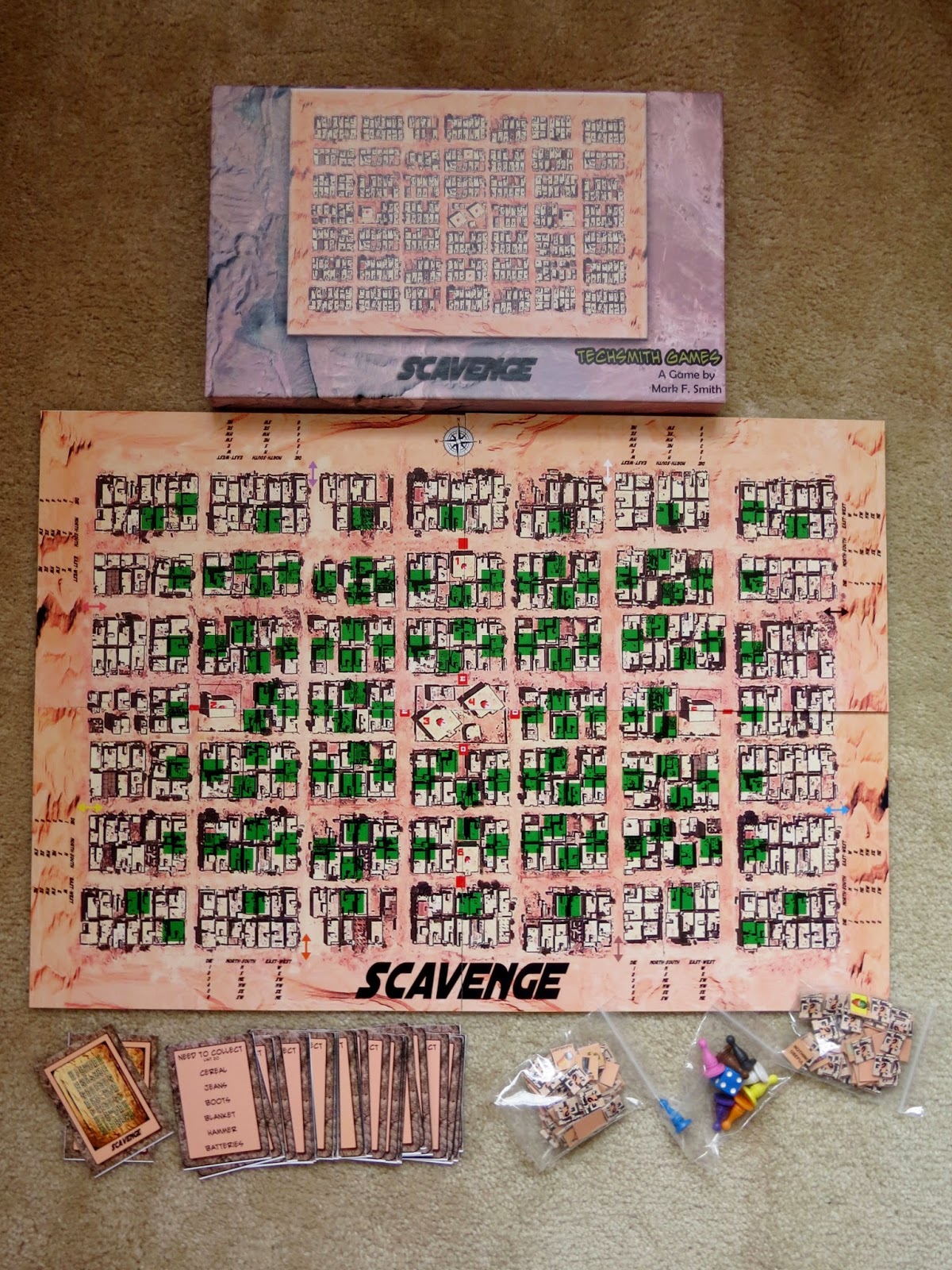
When I finally discovered a place that met my graphic needs for SCAVENGE, I re-activated it and moved it to the head of the line. Because the visual elements are unlikely to be affected by tweaks to the game-play during testing, I went ahead with a professional printing of the prototype, as with SC PRIMARY FIGHT! The printer had a mean glitch in his order software, which fortunately I detected just prior to committing the order, which delayed the printing for a week but at least avoided it being printed hopelessly and uselessly wrong. I am, in fact, pleased with how it turned out!

The map is based on part of the city of Tobruk, in Libya. The dusty roads and flat-topped buildings give the sense of a city that was hardscrabble to start with, even though it is now a treasure-trove for the humans who sneak in to bag some needed items. (See my prior post)

The game has been play-tested twice now. I successfully taught it to a 6-yr old, a 9-yr old, and a 10-yr old. My target audience is age 11-14 and their families. That seems to fit with my observations - the younger kids didn't really have the attention span, even if they understood the game, and the adults who have played didn't regard it as terribly fun. My challenge in development will be to compress the play-time further, reduce the time spent on moving patrolbots, and add more interaction.

Two more designs have hit my bin of ideas to continue developing. RAILROAD MOGUL uses a patch of pre-RR countryside with several small towns and nearby resource locations, like mines and logging camps. Each player receives a commission to start short-line service between a pair of towns. As they build their rail networks, extending it to other towns and resource sites, the towns grow and evolve. The challenge is to grow smarter than your opponents, so that you can fund a bigger rail system and acquire a larger working income.

WIZARDS DEFENSE has an interesting (to me, at least!) premise: wizards are tasked with preparing the City for repelling a pending invasion by a hostile power. Starting with no standing army, they must quickly create one from raw human recruits and various beasts & birds they can acquire in the countryside. The combat system will involve Color Magic, where the interaction of colors provides buffs and nerfs - and since the days of the week are associated with colors, the line-up of who has the best chance to beat whom depends not only on their weapons & training, but the color of their unit Banner and the day they will fight!

More especially, the Invading Power can be chart-controlled. This will allow the game to be played solitaire, or by a pair of players who must cooperate to save the City, or by two teams of players.